
“What happens when US money fails … and Bitcoin is ossified because it’s filled with spam?”
– Jack Kruse
The question that stayed with me after Jack’s appearance on the Bitcoin Infinity Show.
When I heard that Jack Kruse’s interview with Natalie Brunell had been censored, it made me curious. Rather than speculate about what had been said, I went looking for a fuller account of his thinking and listened to his discussion with Knut Svanholm instead.
I’m glad I did.
The history lesson alone was worth the time. Jack’s discussion of the robber barons, Fabianism, the Flexner Report and the gradual capture of major institutions was fascinating. It was detailed, coherent and genuinely thought-provoking. In fact, I found very little in that part of the conversation to disagree with.
But when the discussion turned to Bitcoin, spam and BIP110, I found myself unconvinced.
Not because I think the concerns are irrational. They are worth discussing. But the explanation became much thinner just as the proposed consequences became much larger. One question kept coming back to me:
How?
Background: What is BIP110?
BIP110 is a proposal to further restrict how much non-monetary data can be stored in the OP_RETURN field (a small section of a Bitcoin transaction designed for storing arbitrary data). Today, Bitcoin nodes already have configurable relay policies that influence which new transactions they forward to miners, but these are local policy rules rather than consensus rules. BIP110 would tighten this limit to 83 bytes, reducing the amount of non-monetary data that can be stored directly in OP_RETURN. Importantly, this would not prevent a determined spammer from consuming close to an entire block’s worth of blockspace by instead encoding data in spendable outputs, increasing the UTXO set.
A Different Meaning of ‘Ossification’
Returning to Jack’s discussion on the Bitcoin Infinity Show, one of the first things that caught my attention was his use of the word “ossification.”
In Bitcoin, ossification usually means the underlying protocol becomes increasingly difficult to change. There is a plausible case that this is desirable. A global monetary protocol securing immense value should not be constantly reshaped according to every new concern or preferred vision.
Jack seemed to use the term differently: Bitcoin becomes ‘ossified’ because blocks fill with spam and Layer 1 stops being used in a meaningful monetary way.
Those are not the same thing. One concerns the stability and changeability of Bitcoin’s rules. The other concerns how scarce block space is used.
Even accepting his broader meaning for the sake of argument, I still come back to the same question:
How do blocks become permanently captured by non-monetary activity?
Bitcoin has already lived through the block size wars, Ordinals, inscriptions, runes and periods of sharp fee pressure. None of those arrived invisibly. Everyone could see the blocks, the fees and the mempool. The network did not wake up one morning to discover that Layer 1 had been quietly lost forever.
The framing can make the threat sound like a Fabian march through the blockchain: small steps, unnoticed until the system is captured and unable to respond. But Bitcoin is not a passive institution waiting to be taken by surprise. Its participants observe what is happening in real time. They change behaviour, build tools, improve higher layers, alter local policy, and – if a problem becomes sufficiently real and costly – can consider changing consensus.
That does not guarantee every future problem will be solved easily. But the burden is to explain why the fee market, engineering, Layer 2 and the network’s capacity to respond would all fail – not simply assume that they will.
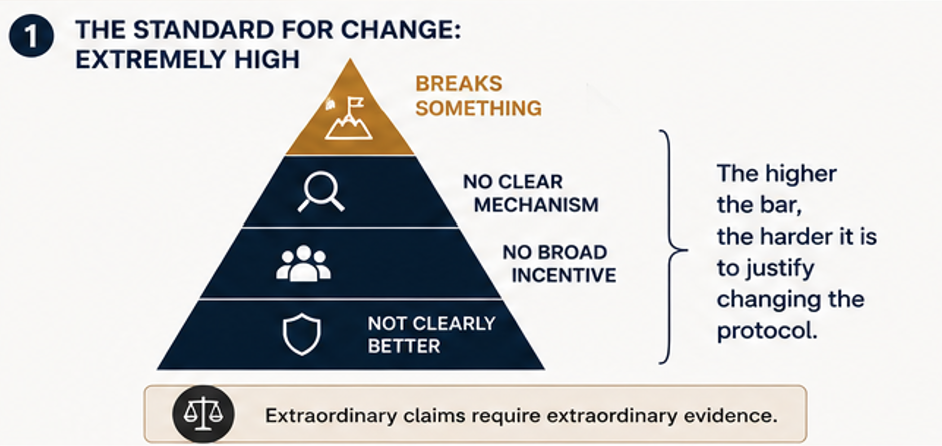
‘Gold 2.0’ Is Presented as a Warning – But Why?
The same gap appears in the warning that Bitcoin could become ‘Gold 2.0’, as though becoming the world’s premier store of value would represent a failure because Bitcoin would no longer be money.
Hang on. How can Bitcoin become Gold 2.0 and somehow not remain money?
If the market establishes Bitcoin as the dominant store of value, that creates more -not less – incentive to use it as a settlement asset and to build financial infrastructure around it. Layer 1 does not need to process every coffee purchase. Scarce settlement space can be priced by fees while Layers 2 and 3 handle everyday, batched or streamed transactions.
That is not Bitcoin ceasing to be money. It is money developing layers.
Gold’s weakness as everyday money came from its physical limitations: transport, divisibility, verification and settlement. Bitcoin is digital, globally verifiable and already supports higher-layer payment systems. So the claim needs a mechanism. How do the fee market and those higher layers stop functioning? How does a globally demanded monetary asset cease being money merely because its base layer is valuable and scarce?
Without that explanation, ‘Gold 2.0’ sounds more like a warning label than a demonstrated outcome.
The ‘70% Spam’ Statistic
Another moment that stood out was the claim that around 70 per cent of recent activity was spam.
At first glance, that sounds alarming. But my immediate question was not whether the figure was accurate. It was: 70 per cent of what?
Transaction count? Block weight? Fee revenue? And, most importantly, did it actually crowd out monetary transactions?
Those are very different claims. A large share of transaction count may consume a much smaller share of block space. Even a large share of block space does not automatically prove failure if higher-paying monetary transactions are still clearing through the fee market.
If monetary transactions were being persistently excluded and Bitcoin’s monetary function was genuinely deteriorating, that would be meaningful evidence. But simply classifying activity as spam does not establish that. The label expresses a judgment about purpose; it does not, by itself, show what broke.
So what actually failed?
Why SegWit Kept Coming to Mind
As I listened, I kept thinking back to SegWit.
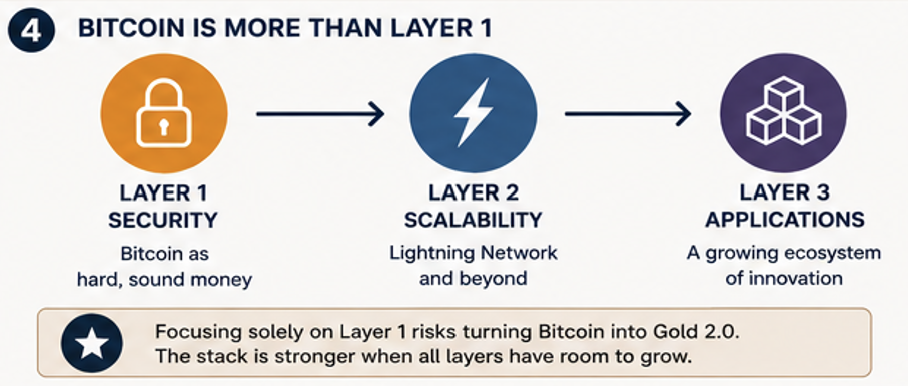
SegWit had clear and immediate incentives. It reduced effective transaction size and fees, improved batching, fixed transaction malleability, supported better address formats and made a practical Lightning Network possible. Exchanges, wallets, users, developers and payment businesses could see direct value in adopting it.
Even with those benefits, activation took roughly two years.
BIP110 does not appear to offer a comparable day-one benefit across the ecosystem. Its case is mainly preventative: restrict certain uses now to avoid a possible future burden. Preventative measures can be justified, but they face a higher bar – especially when they alter consensus and may reduce flexibility for future monetary or Layer 2 constructions that we cannot fully anticipate.
There is also no objective consensus definition of ‘spam’. A transaction either satisfies the rules or it does not. Intent is difficult to infer, and determined users can still consume block space or create UTXOs through other consensus-valid constructions. That makes the proposed benefit narrower than some of the rhetoric suggests.
The Austrian Ideal – and the Real Market
I understand the Austrian ideal behind the argument. Bitcoin as pure money, with its scarce base layer used only for monetary settlement, is a beautiful concept to work towards.
But reality is rarely that clean. Markets decide how scarce resources are used. If someone pays the market price for block space and satisfies Bitcoin’s rules, their transaction competes with every other transaction.
Taking the pure-money ideal as an absolute would invite a long list of proposed ‘improvements’ to Bitcoin. That is fine – put them forward. Debate them. Let participants assess the trade-offs. But no single interpretation of perfect money gets to dictate the rules.
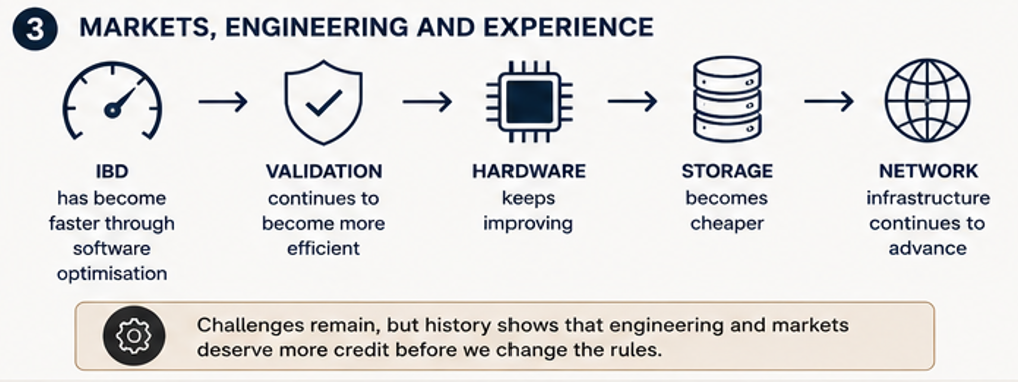
The onus remains on those proposing change to show why the status quo is no longer sufficient and why their solution creates enough value for participants to accept its costs and risks.
Engineering Deserves More Credit
Why is my burden so high?
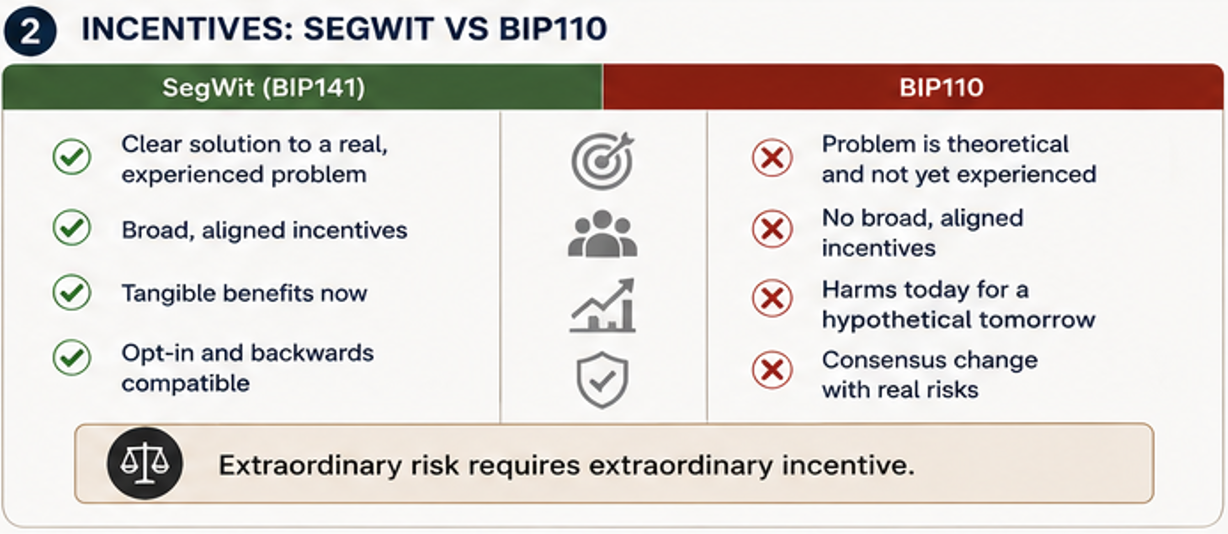
Because I think Bitcoin’s history has consistently shown that engineering, markets and participant incentives deserve more credit before we conclude that consensus rules need to change. History is full of examples where apparent limits were overcome through engineering rather than redesigning the underlying protocol.
The Internet is perhaps the best example. Decades ago, many believed its underlying architecture would eventually become the bottleneck. Instead, engineering repeatedly found ways to improve performance without fundamentally changing the protocol itself.
I’m not claiming Bitcoin will follow exactly the same path. But I am reluctant to underestimate what another decade of engineering might achieve before concluding that consensus changes are necessary.
Bitcoin already has a history of engineering improving the practical experience of running a node. Initial Block Download has become faster through software optimisation. Validation continues to become more efficient. Hardware keeps improving. Storage becomes cheaper. Network infrastructure continues to advance.
None of these developments eliminate Bitcoin’s long-term scaling challenges. But they demonstrate that engineering has repeatedly reduced real-world costs without requiring consensus changes. The same philosophy applies to quantum computing. Nobody denies it’s a plausible future challenge. Research continues. Yet there has been no rush to change Bitcoin’s consensus rules today simply because a future problem is conceivable.
That seems like a sensible philosophy here too.
My Short-Term Prediction
My short-term prediction is fairly uneventful.
I do not think there are strong enough incentives across exchanges, wallets, merchants, custodians, users, developers and miners to move Bitcoin’s consensus rules now. Signalling will remain modest. If a BIP110 UASF proceeds without broad support, I expect it to carve out a minority path rather than materially alter Bitcoin’s main chain.
That would not settle the broader argument about spam. The debate will continue, and perhaps a future proposal will be more compelling. But I suspect it would end this particular implementation proposal, at least in its current form.
The Most Reasonable Path
Overall, I am glad I listened to the podcast. The historical discussion alone made it worthwhile, and these conversations are healthy for Bitcoin.
None of this means Jack or BIP110 supporters are unreasonable. They are raising legitimate concerns about Bitcoin’s future.
I simply do not think the case presented is strong enough to justify moving beyond the status quo today.
The problem is not entirely hypothetical. People do place non-monetary data on-chain. Blocks can fill and fees can spike. But the leap from those facts to Bitcoin becoming ossified, captured by spam and reduced to a non-monetary Gold 2.0 is highly speculative. It draws a long bow while giving too little attention to fees, engineering, higher layers and the network’s capacity to respond.
Perhaps one day experience will reveal a sustained failure that existing incentives and engineering cannot adequately address. If participants then see enough value in a consensus change, Bitcoin can evolve.
But that is different from demanding abstract proof today. Bitcoin’s history is one of participants seeing and experiencing real problems, recognising direct value in a solution, and voluntarily converging on new rules.
For now, maintaining the status quo is, in my view, the most reasonable path.
Markets, engineering and experience should be allowed to reveal which problems genuinely matter. Consensus should evolve when enough participants see clear value in changing the rules – not because an urgent future can be imagined.